
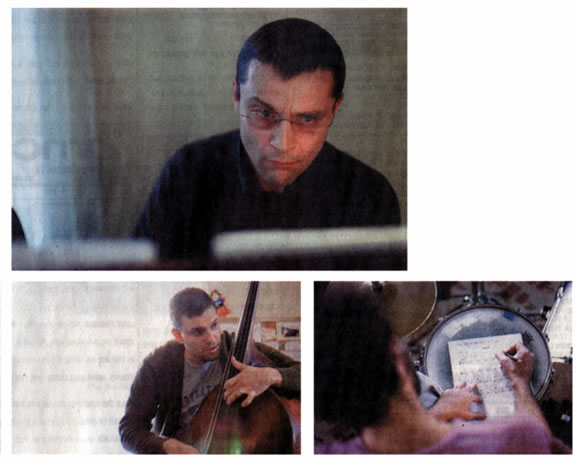
Photos by Dina Rudick/Globe Staff
Boston.com
The Boston Globe
Pianist focuses on the essentials
By Kevin Lowenthal, Globe Correspondent | December 9, 2005
Born in Athens, jazz pianist and composer Pandelis Karayorgis has pursued his musical career in Boston, the Athens of America. Given that trajectory, it seems fitting that his music is so cerebral. Yet his playing and compositions never lack feeling.
In the past few years, Karayorgis, youthful at 43, has come into his own as a player, composer, and bandleader. His ongoing projects include the Pandelis Karayorgis Trio, with bassist Nate McBride and drummer Randy Peterson, and his electric piano group, the mi3, with McBride and drummer Curt Newton. Tonight, he brings yet another trio to Cambridge's Zeitgeist Gallery, featuring Jef Charland on bass and Eric Rosenthal on drums.
Karayorgis has forged a personal style influenced by the all-stars of left-of-center jazz piano: the idiosyncratic architecture of Thelonious Monk, the serpentine lines of Lennie Tristano, and the flinty spareness of Ran Blake, among others. What these figures have in common, says Karayorgis, is their purity of focus. Following these forebears, he says, ''I try not to play everything that I possibly could on piano. Playing is really about constant editing. You want to focus on what is really central."
When he speaks about music, Karayorgis leans forward and his eyes light up. His prominent widow's peak and infectious grin give him a mischievous mien. Seated at the piano, eyes closed, head bowed over the keys, right leg dancing a sidelong shuffle, he and the instrument seem one. Whether solo, in duet, or with his varied trios, his music remains remarkably open and conversational, moving logically yet unpredictably from phrase to phrase.
Case in point: last year's solo piano recording ''Seventeen Pieces," a set of deep, deft, and witty ruminations on Ellington, Monk, Tristano, Sun Ra, and his own compositions. The textures are punctuated with integral silences, the melodies sprinkled with dissonant tone clusters and scribbling runs. There's no heart-on-your-sleeve emoting here. Instead, there's what Karayorgis, describing Tristano's music, calls ''a subtler shade of passion."
Karayorgis's father was a surgeon, his mother an amateur pianist. He began classical piano lessons at the age of 9, but by the end of high school he was in love with jazz and beginning to play gigs. He studied business administration for four years, in accord with his parents' wishes. But ''what I was really interested in was studying jazz," he says.
In 1985, Karayorgis came to Boston to attend the New England Conservatory. He was excited to learn from renowned musical thinkers such as Blake, Jimmy Giuffre, and George Russell. But his most influential teacher was the least famous: pioneering avant-garde reed player Joe Maneri.
''Some of Joe's ideas became very central to my musical thinking," he says. ''For example, in Joe's teaching there is an emphasis on ridding music of extraneous elements, just focusing on simple things like phrasing that is devoid of other references, or on the flexibility of time."
Receiving his bachelor of music degree in 1989, Karayorgis returned to Greece for his two-year compulsory military service. But 1991 found him back at NEC, pursuing his master's.
Enter Karayorgis's longtime collaborator McBride, then an NEC undergraduate but currently living in Chicago and playing bass in several of saxophonist Ken Vandermark's ensembles.
''I'd heard from a couple people that there was this piano player floating around school who had transcribed a lot of Monk's music," he recalled by telephone. ''At the time there was not a readily available source for written-out copies of Monk's compositions. And that made a big impression, dedicating that much time to that music." The two worked on Monk's compositions together. The following year, McBride anchored Karayorgis's student group, the Thelonious Monk Repertory Ensemble.
Tonight's trio will be a departure from Karayorgis's regular groups. ''It's mostly originals, but we're doing two or three Misha Mengelberg tunes," he says. ''Mengelberg is probably my favorite living pianist of the older generation. One of the things he likes to do is take very simple chord progressions and then play very outrageously wrong things on top of them. I just love his choice of notes -- they're just the right wrong notes all the time.
''This is going to be a little more straight ahead than what I do with [McBride] and [Peterson]," he adds with a laugh, ''so you can bring children and families."
Last Saturday afternoon, this trio rehearsed at the trim house in Cambridgeport where Karayorgis lives with his wife, Julia Werntz, a microtonal composer, and their 7-year-old daughter. Having dispatched the Mengelberg tunes earlier, they launched into several Karayorgis originals. The sinuous ''Heart and Sack" evolved into a duet for drums and piano. Here, as throughout, the trio's interplay was notably spontaneous and free, rarely stating the beat but swinging on parallel tracks of momentum that shifted in and out of synch. On the abstract blues ''Betwixt," Charland's bass provided pithy undertow in counterpoint to Rosenthal's jaunty drum commentary and Karayorgis's splintery clusters. ''How Daisies Jiggle" was a dissonant yet affectingly melodic ballad, Billy Strayhorn meets Anton Webern.
McBride feels that these and other Karayorgis compositions may be his greatest contribution to the music. ''Pandelis is an expert writer of melodies," he says, ''structures of notes which are not only beautiful and memorable but durable and therefore mutable by improvisers. You can zero in on any one part of his melodies and find a kernel of structure which you can explore for quite a while before you run out of ideas."
Pandelis Karayorgis, Jef Charland, and Eric Rosenthal perform at the Zeitgeist Gallery tonight. The Daniel Levin/Nate Wooley Duo opens. Program starts at 9:30.
Suggested donation $12. Call 617-876-6060 or go to www.zeitgeist-gallery.org.
© Copyright 2005 The New York Times Company
link to original article